What Is A KRC-20 Token?
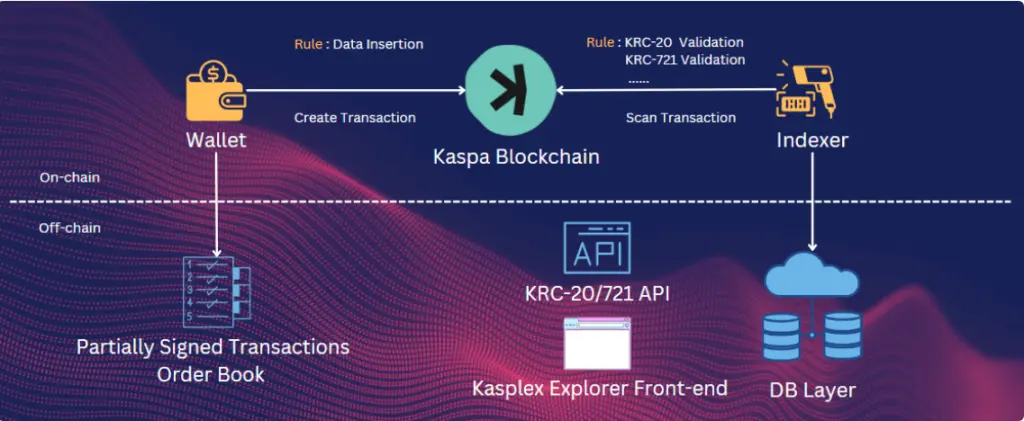
Kasplex is a project related to the Kaspa blockchain that provides an open-source indexer and API that allows developers and users to efficiently retrieve and verify data related to KRC-20 tokens, non-fungible tokens (NFTs), and other digital assets on the Kaspa blockchain. KRC-20 is a token standard defined on the Kaspa blockchain, just like the ERC-20 standard on Ethereum. KRC-20 provides a set of specifications for tokens on the Kaspa blockchain, allowing these 20 tokens to be created, traded, and integrated into different applications and services while following the same standards.
Differences Between KRC20 and ERC20 & BRC20
- 1) Blockchain Platform:
ERC20 is based on Ethereum, BRC20 is based on Bitcoin, and KRC20 is based on Kaspa. - 2) Smart Contract Capabilities:
ERC20 tokens can utilize Ethereum’s smart contract functionality, while the smart contract capabilities of BRC20 and KRC20 depend on the support of their respective platforms. - 3) Performance and Throughput:
Each platform is designed with its own advantages. Ethereum excels in smart contracts, Bitcoin is known for its security, and Kaspa focuses on providing faster transaction speeds and higher network throughput through its blockDAG architecture enabling high-speed transactions.
In general, these token standards are designed to meet the needs of different blockchain networks, and each standard has its own unique advantages and applicable scenarios, such as enabling in-game economies and gaming applications.
How KRC20 Token Works?
- 1) Token creation:
Developers can create new KRC20 tokens by writing smart contracts. These contracts define the basic properties of the token, such as name, symbol, initial supply, etc.
Contracts are usually written in Rust, a language suitable for writing high-performance code that can take full advantage of the underlying architecture of the Kaspa blockchain. - 2) Token transfer:
KRC20 tokens must implement a set of standard interfaces, including basic methods for transfers, such as transfer and approve so that users can send tokens between different addresses.
Users can use wallets that support the KRC20 standard to manage their tokens, including sending, receiving, and authorizing others to use their tokens. - 3) Token storage:
KRC20 tokens can be stored in wallets that support the Kaspa network, which can be hardware wallets, software wallets, or custody services provided by exchanges. - 4) Token interaction:
Because KRC20 tokens follow standard interfaces, they can interoperate between different applications, such as trading on decentralized exchanges (DEX), or participating in lending, staking, and other activities as part of decentralized finance (DeFi) applications. - 5) Security and Compliance:
Token creators need to ensure that their smart contracts follow best practices to prevent security vulnerabilities, such as reentrancy attacks.
Legal and compliance issues also need to be considered, especially when it comes to tokens of a security nature, and relevant laws and regulations need to be followed. - 6) Tools and Support:
Developers can use the developer tools and resources provided by Kaspa to create and test their KRC20 tokens.
Third-party tools and services, such as KatScan, can provide further analysis and support for KRC20 tokens.
How Does KRC-20 Affect Mining Kaspa?
KRC20, as a token standard on the Kaspa blockchain, does not itself directly affect the mining process of KASPA coins. However, the existence of KRC20 tokens and their applications may indirectly affect the value of KASPA coins and the development of the ecosystem, thus having some potential impact on mining. Here are some possible impacts:
- 1) Ecosystem growth:
The increase in KRC20 tokens means that applications and services on the Kaspa network become more diverse, which may attract more users and developers to join the Kaspa ecosystem.
More applications and services can enhance Kaspa’s overall value proposition, which may increase demand for KASPA coins. - 2) Transaction fees:
Transactions conducted on the Kaspa network, including transactions of KRC20 tokens, usually require transaction fees. These fees are paid in the form of KASPA coins, so as the volume of KRC20 token transactions grows, the demand for KASPA coins may increase. - 3) Network effect:
If KRC20 tokens become popular, more users may start holding KASPA coins to participate in activities related to these tokens, such as participating in DeFi applications, staking, or governance voting.
This network effect may cause the value of KASPA coins to rise, which in turn affects miners’ earnings expectations. - 4) Mining rewards:Mining rewards remain one of the main sources of KASPA coins. Although the existence of KRC20 tokens will not change the mining reward mechanism itself, if the value of KASPA coins rises due to ecosystem growth, then the rewards obtained from mining will also be more valuable. Now Bitmain released Antminer KS5 20T & KS5 PRO 21T , and IceRiver released KS5L 12T, KS5M 15T, KS2 Lite 2T pre-order in October. Both manufacturers are main producing Kaspa miners.
- 5) Security and mining motivation:
KRC20 tokens increase economic activity on the network, which in turn increases the demand for network security. More economic value locked in the network may incentivize more miners to participate in order to ensure the security and stability of the network.
In summary, although the KRC20 standard itself is not a factor that directly affects KASPA coin mining, it indirectly affects the value of KASPA coins and miners’ earnings by promoting the prosperity of the Kaspa ecosystem. Therefore, the prosperity of KRC20 tokens helps create a healthier and more active Kaspa network, which may be a positive signal for miners.
In Conclusion
The mainnet launch of Kaspa and the growth of blockchain-based projects and KRC-20 token on its platform are all part of the latest Kaspa news today. Understanding the kaspa’s meaning and potential is the key for investors and developers.
Tools like the Kaspa whale chart and Kaspa coinmarketcap can provide insights into price action, support levels, resistance levels, whale activity, and more to inform trading decisions. Wave analysis suggests Kaspa may be in a bullish wave that could potentially lead to new all-time highs.
The innovation happening in the Kaspa ecosystem, from the tokenization of assets and real-world assets to the DeFi expansion into lending platforms and more, is attracting a lot of attention. As Kaspa continues to evolve, it has the potential to make a major impact.
Finally, YesMining would like to remind everyone that all investments come with inherent risks, so it’s important to proceed with care.
If you are interested in Kaspa mining, you can contact our Yesmining to provide the best option for you. Yesmining is a verified and professional supplier in this industry to provide you with a one-stop solution.

 English
  Russian
  Spanish
  French
  German